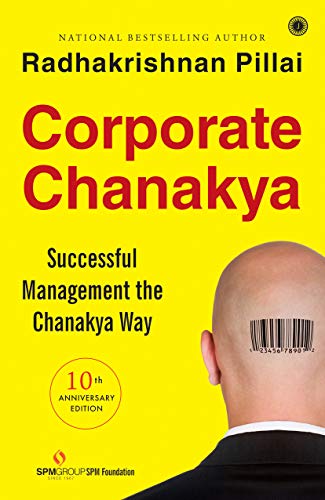
⚡️ What is Corporate Chanakya About?
Have you ever wondered if the cutthroat politics of ancient Indian kingdoms actually look any different from a modern boardroom? I picked up Corporate Chanakya expecting a dry history lesson, but what I found instead was a pragmatic, almost cold-blooded manual for getting things done. Radhakrishnan Pillai, who spent years studying Kautilya’s Arthashastra, argues that while our technology has changed, the human ego, power dynamics, and the messiness of management haven’t changed a bit in over two millennia.
The central thesis here is that leadership isn’t a title; it’s a rigorous daily discipline. You’ll find more summaries by Radhakrishnan Pillai on our site, but this one remains the foundation of his work. He breaks down the 6,000 aphorisms of Chanakya into three distinct buckets: Leadership, Management, and Training. It’s a book for anyone who feels like the standard Western management fluff is failing them in the real world. If you’re looking for more management book summaries, this is the one that trades corporate buzzwords for ancient, battle-tested wisdom.
🚀 The Book in 3 Sentences
- Success in business requires a blend of ethical vision and ruthless strategic pragmatism.
- The ability to lead others is entirely dependent on your ability to master your own senses and discipline your own routine.
- Ancient Indian governance principles provide a complete framework for organizational structure, from hiring ‘ministers’ to training the ‘army.’
🎨 Impressions
Reading this felt like getting a stern lecture from a grandfather who also happens to be a retired intelligence officer. It’s refreshing because it doesn’t try to be “nice.” Pillai doesn’t sugarcoat the reality that competition is real and that people are often driven by self-interest. I’ve read dozens of business books that pretend we’re all just one happy family, but this book respects you enough to admit that corporate life is often a chess match.
What I loved most was the structure. It’s composed of very short chapters—sometimes just two pages—which makes it feel like a daily devotional for the ambitious. There was one section on “Power” that actually made me stop and re-read it three times because it challenged my assumption that power is something to be avoided or shared. In Chanakya’s world, power is a tool that, if not gripped firmly, will be used against you. It’s a bit jarring, but it’s undeniably honest.
📖 Who Should Read Corporate Chanakya?
If you are a manager who feels like you’re losing control of your team’s direction, or an entrepreneur trying to build a culture from scratch, this is your playbook. It’s especially useful for those who find Western management theories a bit too idealistic or disconnected from the reality of office politics. However, if you’re looking for a deep, academic dive into history, you’ll be disappointed; this is very much a “how-to” for the modern office, not a history textbook.
☘️ How This Book Changed My Thinking
I used to think of management as something that happened only when I was in the office, but Pillai convinced me that the “corporate” part of Chanakya starts the second I wake up. My mindset shifted from seeing management as a job function to seeing it as a personal philosophy of self-mastery.
- I stopped viewing “politics” as an evil to be ignored and started viewing it as a landscape to be navigated with integrity.
- I adopted the “Three Question” filter before starting any new project, which saved me from two dead-end collaborations this year.
- I realized that my “ministers” (my core team) need more than just technical skills; they need a shared philosophy of discipline.
✍️ 3 Quotes That Stuck With Me
- “A person should not be too honest. Straight trees are cut first and honest people are screwed first.” — This hit me like a bucket of ice water; it’s a brutal reminder that naivety is not a virtue in business.
- “Before you start some work, always ask yourself three questions — why am I doing it, what the results might be, and will I be successful.” — I’ve written this on a sticky note on my monitor; it’s the ultimate guard against busy-work.
- “A man is great by deeds, not by birth.” — This is the ultimate meritocratic battle cry, reminding us that your pedigree matters less than your output.
📒 Summary + Notes
The book isn’t a long-winded argument; it’s a collection of modular lessons. Pillai builds a case that a leader’s success is determined by their ‘Rajrishi’ status—being a kingly sage. This means having the authority of a ruler but the self-control of a monk. He takes you through the lifecycle of a professional, starting with how you manage your own time and thoughts, moving into how you manage a team, and ending with how you train the next generation.
By the end, the author wants you to believe that the most powerful weapon in any corporate arsenal isn’t capital or technology, but ‘Anshvikshiki’ (the science of thinking). He argues that if you can out-think your opponent and out-discipline your peers, the market will naturally bow to your strategy. It’s about building a legacy that outlasts your tenure, much like Chanakya’s Maurya Empire outlasted him.
Section 1: Leadership (The Raja)
What makes a leader worth following in an age of job-hopping and quiet quitting? Pillai argues that it starts with ‘Vijigishu’—the desire to conquer. But this isn’t just about conquering market share; it’s about conquering your own laziness and ego. A leader who cannot wake up on time or control his tongue in a meeting has no right to demand discipline from his subordinates.
One of the most punchy ideas here is the concept of the ‘Leader’s Council.’ You shouldn’t make decisions in a vacuum. Chanakya suggests that even the most intelligent king needs at least three or four advisors. Why? Because one person is biased, two might argue, but three or more create a diversity of thought that reveals the ‘hidden’ flaws in a plan. Don’t be the lonely genius; be the hub of a brilliant network.
- The Three Questions: Never start a task without knowing the ‘Why,’ the ‘Result,’ and the ‘Probability of Success.’
- Power Dynamics: Power is not a dirty word; it’s the energy required to drive an organization forward.
- Ethics: A leader without a moral compass is just a tyrant, and tyrants always get overthrown by their own people eventually.
Section 2: Management (The Amatya)
Imagine your management team as the ‘pillars’ of a temple. If one is weak, the whole roof caves in. Pillai focuses heavily on ‘Amatya’ (the ministers) and how to select them. He makes a controversial claim: loyalty is just as important as competence. A genius who is working against you is more dangerous than a mediocre worker who supports you. Do you know who in your team is actually in your corner when the doors are closed?
The book spends a lot of time on the logistics of management—meetings, reporting, and time-tracking. Chanakya was a fan of splitting the day into eight parts. In a modern context, this means batching your work. Don’t check emails while you’re supposed to be strategizing. There’s a time for ‘seeing’ (monitoring), a time for ‘doing’ (execution), and a time for ‘thinking’ (planning). If you mix them, you do none of them well.
Section 3: Training (The Shishya)
You’re at a conference and everyone is talking about “upskilling,” but Chanakya was talking about this in 300 BC. He viewed training not as a one-time HR seminar, but as a continuous apprenticeship. The author suggests that a company is only as strong as its ‘second line’ of leadership. If you died tomorrow, would your business collapse? If yes, you haven’t been a leader; you’ve been a bottleneck.
The training section emphasizes the ‘Shastra’ (theory) and ‘Shastravidya’ (practice). You can’t just read books like this and expect to be a CEO. You have to apply the sutras in small, low-stakes situations before you try to use them to pivot a multi-million dollar company. It’s about building ‘Sanskara’—good habits that become second nature. You don’t rise to the level of your goals; you fall to the level of your training.
⚖️ A Critical Perspective
While the wisdom is timeless, Corporate Chanakya occasionally suffers from being a bit too bite-sized. Because the chapters are based on short columns, some of the advice can feel repetitive or overly simplified for complex 21st-century problems like remote-work culture or global supply chain ethics. Additionally, some of Chanakya’s more “ruthless” suggestions about surveillance and skepticism might create a toxic culture of low trust if applied literally in a modern startup. It’s a book that requires the reader to use a lot of discretion—take the strategic mindset, but perhaps leave the 4th-century espionage tactics at the door.
🔄 How It Compares
Compare this to The 48 Laws of Power by Robert Greene. While both books explore the darker, more pragmatic side of strategy, Corporate Chanakya is anchored in a sense of “Dharma” or duty. Greene’s work can feel nihilistic, whereas Pillai (via Chanakya) insists that power must ultimately serve the greater good of the ‘kingdom’ or company, not just the ego of the leader.
🔑 Key Takeaways
These are the actionable levers you can pull starting tomorrow morning:
- The 1:3 Ratio: For every hour of ‘doing,’ spend at least twenty minutes in ‘Aatma-Chintan’ (self-reflection) to ensure you aren’t just running in the wrong direction.
- Select for Character: Skills can be taught in a week; character is forged over a lifetime. Never hire a ‘brilliant jerk’ who fails the loyalty test.
- The Three Pillars: Every successful project requires three things—Prabhu Shakti (the vision/power), Mantra Shakti (the strategy/counsel), and Utsaha Shakti (the energy/execution). If you’re missing one, the project will fail.
- Straight Tree Theory: Be aware that being ‘too nice’ often invites exploitation; maintain a professional edge that commands respect.
💬 Frequently Asked Questions
What is the main argument of Corporate Chanakya?
The book argues that the 2,400-year-old principles found in Kautilya’s Arthashastra are fully applicable to modern business. It suggests that leadership is a discipline of self-mastery, strategic planning, and ethical pragmatism, rather than just a management style or a corporate title.
Does the book promote unethical behavior in business?
No, but it is deeply pragmatic. While it includes warnings like “straight trees are cut first,” it emphasizes that a leader’s power must serve the organization’s welfare. It encourages being ‘smart’ and ‘strategic’ rather than ‘naive,’ but always within the framework of long-term duty.
Who was Chanakya and why is he relevant to CEOs?
Chanakya was the advisor to Chandragupta Maurya and the architect of one of India’s largest empires. CEOs find him relevant because he treated statecraft like a science, focusing on data-driven decision making, risk management, and the psychology of leadership long before modern business schools existed.
What are the three sections of Corporate Chanakya?
The book is divided into Leadership, Management, and Training. Leadership covers self-discipline and vision; Management focuses on organizing teams and resources; and Training deals with developing the next generation of leaders and maintaining organizational standards over the long term.
Is this book better for startups or large corporations?
It’s useful for both. Startups benefit from the ‘warrior’ mindset and lean strategic planning, while large corporations can use the ‘kingdom’ framework to manage internal politics, hierarchy, and succession planning. It’s more about the individual leader’s mindset than the company’s size.
Conclusion
At the end of the day, Corporate Chanakya is a reminder that there is nothing new under the sun. We might have Slack and AI, but the core challenge of getting a group of people to move toward a single goal remains as difficult as it was in the 4th century BC. Radhakrishnan Pillai has done a massive service by stripping away the academic dust and showing us that ancient wisdom isn’t just for museums—it’s for boardrooms.
If you take away only one thing, let it be the idea of the ‘Rajrishi.’ Strive to be the person who has the clarity of a sage but the decisive action of a ruler. In a world full of managers who are either too soft to lead or too arrogant to listen, being a Chanakya-style leader is your ultimate competitive advantage. This book isn’t just a read; it’s a mirror. If you don’t like what you see in your own discipline, start there. The kingdom follows the king.
More From Radhakrishnan Pillai →
Discover more from AI Book Summary
Subscribe to get the latest posts sent to your email.