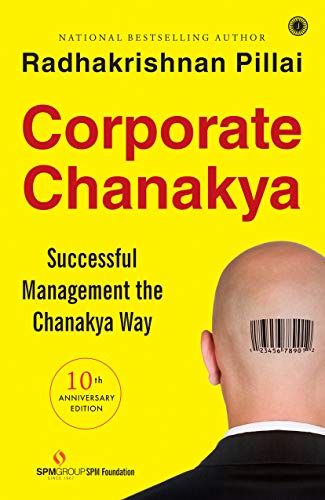
⚡️ What is Corporate Chanakya about?
Corporate Chanakya is about applying the timeless wisdom of the ancient Indian strategist Chanakya to the modern corporate world. Radhakrishnan Pillai brilliantly adapts principles from Chanakya’s Arthashastra, a treatise on economics, politics, and military strategy, into a practical guide for business leaders, managers, and entrepreneurs. The book serves as a comprehensive manual on effective leadership, strategic management, financial prudence, and ethical governance. It delves into how one can build a successful organization by mastering the art of people management, creating robust systems, and making decisions that are not just profitable but also morally sound. Essentially, it’s a roadmap to achieving sustainable success and power in the professional arena by learning from one of history’s greatest thinkers.
🚀 The Book in 3 Sentences
- Radhakrishnan Pillai’s ‘Corporate Chanakya’ masterfully translates the ancient political and economic strategies of Chanakya into practical lessons for today’s corporate leaders.
- It provides a comprehensive framework for effective management, focusing on ethical leadership, strategic thinking, and sustainable wealth creation.
- Ultimately, the book teaches that success in business, much like in ruling a kingdom, hinges on discipline, foresight, and unwavering integrity.
🎨 Impressions
My overall impression of ‘Corporate Chanakya‘ is that it’s a profound and surprisingly practical guide. Pillai’s ability to distill complex strategies from the Arthashastra into actionable advice is what makes this book stand out. It’s not just a theoretical text; it feels like a mentor sharing timeless principles for achieving sustainable success. I found the parallels drawn between ancient kingdom management and modern corporate governance to be both fascinating and incredibly relevant. The book’s emphasis on ethics as a core component of success, rather than an afterthought, was particularly refreshing and impactful in today’s often-cutthroat business environment.
📖 Who Should Read Corporate Chanakya?
This book is essential reading for aspiring and current leaders, managers, and entrepreneurs who want to build a strong ethical foundation for their careers. If you are a CEO, a team lead, or anyone in a position of influence, the Corporate Chanakya strategies will resonate deeply. Even students of business and management will find immense value in its timeless lessons on power, people, and prosperity. It’s for anyone who believes that true success is a blend of sharp intellect, strategic acumen, and unwavering moral character.
☘️ How the Book Changed Me
Reading ‘Corporate Chanakya‘ fundamentally shifted my perspective on leadership from being about authority to being about responsibility. It instilled in me a deeper understanding of how power should be wielded with wisdom and for the greater good of the organization. The book’s principles have become a filter through which I now evaluate my decisions, interactions, and long-term goals.
- Strategic Thinking: I now approach problems with a more long-term, analytical mindset, always considering the second and third-order effects of my decisions.
- Ethical Framework: The book reinforced my belief that ethical conduct isn’t a constraint but a strategic advantage for building trust and a lasting reputation.
- People Management: I’ve started viewing my team not just as employees but as key assets whose growth and well-being are directly tied to the organization’s success.
- Financial Discipline: I’ve become more conscious of the difference between revenue and profit, applying the book’s financial techniques to both my professional and personal life.
✍️ My Top 3 Quotes
- “The power of a leader is not in his position, but in his ability to influence people positively.”
- “Before you start any work, always ask yourself three questions: Why am I doing it? What will be the result? Will I be successful?”
- “A person who cannot decide on his own cannot become a leader.”
📒 Summary + Notes
This summary of Corporate Chanakya breaks down the book’s core teachings, chapter by chapter. Radhakrishnan Pillai systematically presents Chanakya’s wisdom, transforming ancient statecraft into a modern corporate playbook. The journey through this book is about mastering self, managing people, and creating an empire of value, all while adhering to a strict code of ethics. Each chapter builds upon the last, creating a holistic framework for achieving enduring success in any professional endeavor.
Chapter 1: Leadership
This chapter lays the foundation by defining the true qualities of a leader. It argues that leadership is not about titles but about influence, vision, and the ability to inspire. A true leader leads by example, embodying the discipline and values they wish to see in their team. Pillai emphasizes that a leader’s primary role is to protect and nurture their team, creating an environment where everyone can thrive and contribute to the collective goal.
- A leader must practice self-discipline before expecting it from others.
- Power should be used as a tool for the welfare of the organization, not for personal gain.
- The six enemies of a leader are lust, anger, greed, pride, arrogance, and over-excitement, which must be conquered.
- Effective leadership involves mentoring and developing future leaders from within the team.
Chapter 2: Management
Focusing on the ‘how-to’ of running an organization, this chapter delves into the principles of effective management. It discusses the importance of creating efficient systems, processes, and control mechanisms to ensure smooth operation. Pillai stresses that a good manager is like a skilled conductor, ensuring every part of the organization works in harmony. This involves setting clear responsibilities, monitoring performance, and making timely corrections to stay on course.
- Efficient systems are the backbone of a well-managed organization, minimizing chaos and maximizing productivity.
- Regular monitoring and feedback are essential for course correction and continuous improvement.
- Clear definition of roles and responsibilities prevents confusion and empowers employees.
- A manager must be adept at both task-oriented and people-oriented management techniques.
Chapter 3: Strategy
Chanakya was the ultimate strategist, and this chapter translates his strategic genius for the corporate battlefield. It covers the importance of meticulous planning, competitive analysis, and foresight. Pillai explains that a good strategy is not rigid but adaptable, with contingency plans for unforeseen circumstances. The key is to gather accurate information, understand the landscape, and make calculated moves to secure a competitive advantage.
- Strategy is the bridge between where you are and where you want to be.
- Information is the most powerful weapon in a strategist’s arsenal.
- Always have a Plan B; a wise strategist anticipates multiple scenarios.
- Knowing your strengths and weaknesses, as well as those of your competition, is crucial for success.
Chapter 4: Wealth
This chapter explores Chanakya’s pragmatic approach to wealth creation and financial management. It distinguishes between earning (top-line revenue) and wealth (bottom-line profit and assets). Pillai advises leaders to focus on increasing profits, protecting capital, and avoiding unnecessary risks. The book teaches that wealth is a tool for growth and achieving larger goals, not an end in itself. Financial discipline is presented as a cornerstone of a strong and sustainable enterprise.
- The ultimate goal is to increase wealth, not just revenue.
- Protect your capital first, then focus on growth; this is the golden rule of financial management.
- Wealth should be used for the greater good of the organization and society.
- A leader must be financially literate to make sound business decisions.
Chapter 5: Human Resources
Chanakya understood that people are the most valuable resource. This chapter is dedicated to the art of human resource management. It emphasizes recruiting the right people, treating them with respect, and investing in their growth. Pillai advocates for creating a work environment that feels like a family, where employees feel valued, motivated, and loyal. Happy employees lead to happy customers and a successful business.
- Your team is your biggest asset; their success is your success.
- A happy employee is a productive employee; focus on creating a positive work culture.
- Invest in training and development to nurture talent within the organization.
- Recognize and reward good work to motivate and retain top performers.
Chapter 6: Ethics
In this crucial chapter, Pillai underscores that ethics and integrity are non-negotiable for long-term success. He argues that success achieved through unethical means is fleeting and ultimately destructive. The book stresses the importance of honesty, fairness, and transparency in all dealings. An ethical leader builds a culture of trust, which is the most valuable currency in any organization.
- Unethical success is like a house built on sand; it will inevitably collapse.
- Integrity builds trust, which is the foundation of all lasting relationships, both personal and professional.
- Fairness in all dealings is a leader’s foremost duty.
- A good reputation is more valuable than short-term profits.
Chapter 7: Governance
The final chapter ties everything together by discussing the importance of good governance. It’s about creating a framework of rules, policies, and values that guide the organization. Pillai explains that governance ensures compliance, prevents corruption, and promotes sustainability. A leader is the ultimate guardian of the organization’s governance, ensuring that it operates with transparency and accountability at all levels.
- Good governance requires strong laws and their just and impartial implementation.
- Transparency is the best antidote to corruption and internal politics.
- A leader is the ultimate guardian of the organization’s values and culture.
- Sustainable success is built on a foundation of strong governance and ethical practices.
Key Takeaways
The most critical lessons from ‘Corporate Chanakya‘ revolve around the holistic integration of leadership, strategy, and ethics. The book teaches that these elements are not separate but deeply interconnected. True mastery comes from understanding how to lead people, plan for the future, manage resources, and do it all with unwavering integrity. It’s a call to become a more complete and conscious leader.
- Leadership is Influence, Not Authority: The core Corporate Chanakya lesson is that true leadership stems from the ability to inspire and guide, not just command.
- Strategy is Everything: Success is never accidental; it is the result of meticulous planning, foresight, and adaptability.
- Ethics is Non-Negotiable: Long-term success and respect can only be built on a foundation of integrity and fairness.
- People are the Real Wealth: An organization’s greatest asset is its people, and their well-being is paramount to sustainable growth.
- Financial Discipline is Key: Understanding the difference between revenue and profit is fundamental to building a lasting enterprise.
Conclusion
In conclusion, Radhakrishnan Pillai’s ‘Corporate Chanakya‘ is more than just a book; it’s a timeless guide to mastering the art of leadership and management. By bridging the gap between ancient wisdom and modern application, it equips readers with powerful strategies and ethical techniques to navigate the complexities of the corporate world. If you are ready to transform your approach to leadership and build a legacy of success, this book is an indispensable read. It challenges you to not just be a manager, but a visionary leader who builds, nurtures, and governs with wisdom and integrity.
More From Radhakrishnan Pillai →
Discover more from AI Book Summary
Subscribe to get the latest posts sent to your email.