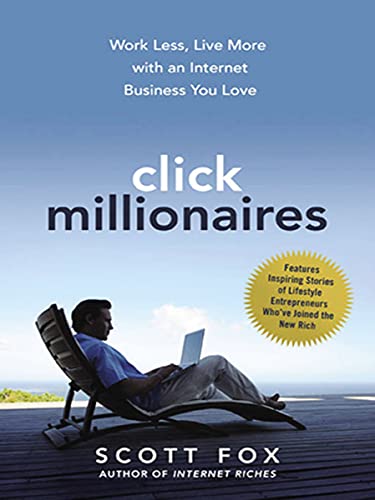
⚡️ What is Click Millionaires About?
I picked this up because I was tired of the ‘hustle’ culture that demands eighty-hour weeks just to make someone else rich. We’ve all seen the Silicon Valley narrative: raise millions, lose your soul, and hope for an exit. But what if you just want to pay for your kid’s college and work from a beach in Portugal? That’s where Scott Fox comes in. In More summaries by Scott Fox, he argues that the real winners aren’t the ones with the biggest offices, but the ones with the most freedom.
The central thesis of Click Millionaires is that the internet has democratized entrepreneurship to the point where your hobbies can actually pay the bills. Fox isn’t selling a get-rich-quick scheme; he’s selling a get-free-eventually system. By using automated tools and niche marketing, you can build a ‘lifestyle business’ that runs while you’re asleep. It’s a foundational text in the business book summaries category for anyone who values time over status symbols.
🚀 The Book in 3 Sentences
- The goal of a modern business should be ‘lifestyle design,’ prioritizing freedom and personal happiness over raw revenue or corporate growth.
- Success comes from identifying a specific niche of people with a problem you enjoy solving, then automating the delivery of that solution.
- By leveraging low-cost internet tools and outsourcing, you can minimize financial risk while maximizing the potential for recurring, passive income.
🎨 Impressions
Honestly, I found the first few chapters a bit ‘rah-rah’ for my taste, but once Fox gets into the nitty-gritty of niche selection, the book really shines. It’s written with a genuine warmth—like a mentor who’s already made his mistakes and wants to save you the trouble. What surprised me most wasn’t the technical advice, but the psychological focus. Fox spends a lot of time talking about the fear of starting and the trap of ‘perfectionism’ that kills most businesses before they launch.
I’ve read plenty of business books that feel like they were written by robots for robots. This wasn’t that. There’s a moment early on where he explains that you don’t need a million customers; you just need a few thousand who really care. That shift in perspective is incredibly liberating. It makes the idea of becoming a ‘millionaire’ feel less like a lottery win and more like a mathematical certainty if you just put in the work. It’s not a perfect book—some of the tech mentions are definitely showing their age—but the underlying logic is bulletproof.
📖 Who Should Read Click Millionaires?
This is for the person who feels stuck in a cubicle and has a hobby they spend all weekend thinking about. If you’re a DIY-er who’s willing to learn the basics of a website and can commit to a year of slow growth, you’ll love this. However, if you’re looking for a blueprint on how to build the next Facebook or raise Venture Capital, look elsewhere. This book is for the solo-entrepreneur who wants to remain solo.
☘️ How This Book Changed My Thinking
Before reading this, I thought ‘passive income’ was a myth reserved for scammers. I assumed you either worked for a salary or you worked 100 hours a week on a startup. Fox showed me a third way.
- I stopped trying to build products for ‘everyone’ and started looking for the smallest viable audience I could serve.
- I began valuing my ‘freedom hourly rate’ instead of just my gross income.
- I realized that ‘outsourcing’ isn’t just for big corporations; I can hire a virtual assistant for $10 an hour to handle the tasks that drain my energy.
✍️ 3 Quotes That Stuck With Me
- “The goal isn’t just to make more money; it’s to have more life.” — This summarizes why we bother with entrepreneurship in the first place.
- “Find a niche that’s an inch wide and a mile deep.” — This is the best marketing advice I’ve ever received, and it’s a recurring theme throughout the book.
- “Don’t trade your time for money; trade your systems for money.” — This is the fundamental shift required to move from ‘freelancer’ to ‘business owner.’
📒 Summary + Notes
The book’s narrative arc moves from the ‘why’ to the ‘how.’ Fox starts by dismantling the 20th-century myth of job security. He makes a compelling case that relying on a single employer is actually the riskiest financial move you can make. From there, he builds a framework for identifying what he calls your ‘Expertise Niche.’ This isn’t just about what you’re good at, but where your skills intersect with a market that is willing to pay.
As you progress through the chapters, Fox introduces the various business models—advertising, affiliate marketing, digital products, and subscriptions. He doesn’t favor one over the others; instead, he encourages you to ‘stack’ them. The final third of the book is a practical manual on automation. He wants you to build a ‘Click Millionaire’ machine that requires minimal maintenance once it’s running. By the end, you’re left with a clear realization: the only thing standing between you and a lifestyle business is your own willingness to start small and stay consistent.
1: The New American Dream
Why are we still following career advice from the 1950s? This chapter opens with a cold splash of reality: the traditional corporate ladder is broken, and loyalty to a company is a one-way street. Fox argues that ‘security’ now comes from having multiple streams of income and a direct connection to your customers.
2: What Is a Click Millionaire?
Being a millionaire doesn’t mean you have a million dollars in the bank; it means you have the lifestyle that most people think requires a million dollars. This is a crucial distinction. Fox explains that if your business covers your expenses and allows you to work four hours a day, you’ve already won. He introduces the ‘Click Millionaire’ lifestyle: high automation, low overhead, and high personal engagement.
3: The Rules of the New Game
Imagine you’re playing a game where the rules changed while you were sleeping. That’s the modern economy. Fox lists the new ‘commandments’ for business success, including:
- Niches lead to riches.
- Automate everything that doesn’t require a human touch.
- Own the platform, don’t just rent space on someone else’s.
4: The Click Millionaire Business Success Principles
Success isn’t about luck; it’s about adhering to specific principles that Fox has observed in hundreds of successful online businesses. He emphasizes the importance of ‘Scalability’—can your business grow without you working more hours? He also stresses ‘Low Overhead,’ which keeps your stress levels low and your profit margins high. Have you checked your recurring subscriptions lately? Small leaks sink big ships.
5: Redefining Your Relationship with Money
Midway through a thought on financial freedom, Fox stops to ask: what is money actually for? Most of us are on a hedonic treadmill, working harder to buy things we don’t need to impress people we don’t like. This chapter is a mental reset, encouraging you to see money as ‘freedom fuel’ rather than a scorekeeper. It’s one of the more philosophical sections, and honestly, the one I dog-eared the most.
6: How to Find Your Niche
There’s a scene early on in this chapter where Fox helps a reader realize that their obsession with vintage tractors is a goldmine. Finding your niche isn’t about ‘picking a winner’ in the stock market; it’s about looking at your own life and identifying where you have ‘asymmetric information.’ What do you know more about than 90% of the population? That’s your business.
7: The Click Millionaire Business Model Matrix
How do you actually turn an idea into cash? Fox provides a matrix that helps you decide which business model fits your personality. Are you a writer? A teacher? A curator? He breaks down the pros and cons of different approaches so you don’t waste months building a model that makes you miserable. It’s a structured way to avoid the ‘shiny object syndrome’ that kills so many new entrepreneurs.
8: Lifestyle Business Model 1: Advertising and Lead Generation
The simplest way to start is by selling attention. This chapter covers the basics of Google AdSense and selling leads to local businesses. While this model requires high traffic to be truly lucrative, Fox points out it’s the easiest ‘set and forget’ method for beginners. But does this still work in the age of ad-blockers? Yes, but you have to be more creative about where those ads live.
9: Lifestyle Business Model 2: Affiliate Marketing
Why build a product when you can just recommend someone else’s? Affiliate marketing is the ‘gateway drug’ to online business. Fox explains how to build trust with an audience so that your recommendations actually carry weight. He warns against the ‘spammy’ affiliate tactics that give the industry a bad name and focuses on high-value, honest reviews.
10: Lifestyle Business Model 3: Info-Products and Premium Content
This is where the real ‘Click Millionaire’ magic happens. Creating an E-book or an online course allows you to sell your knowledge an infinite number of times without any additional cost. Fox walks you through the creation process, from outlining your content to setting up a digital delivery system. This is the chapter that convinced me to finally start writing my own guides.
11: Lifestyle Business Model 4: Services and Subscriptions
Can you turn a one-time service into a recurring monthly fee? Subscriptions are the holy grail of business. Fox explains how to build a ‘membership site’ or a service-based business that provides predictable, steady income. He emphasizes that the ‘community’ aspect of a membership site is often more valuable to members than the content itself.
12: Software and Tools
You don’t need a computer science degree to build an internet business. This chapter is a shopping list of the tools you need to get started. While some of the specific recommendations are dated (it was written in 2012), the *types* of tools—email autoresponders, content management systems, and payment processors—are still exactly what you need today.
13: Outsourcing and Automation
If you’re doing everything yourself, you don’t have a business; you have a job. Fox introduces the concept of the ‘Virtual Assistant’ and explain how to delegate the tasks you hate. He provides specific advice on where to find talent and how to manage them without losing your mind. This is the ‘Work Less’ part of the book’s subtitle in action.
14: Marketing Your Click Millionaire Business
How do you get people to actually show up to your site? Marketing isn’t about yelling at people; it’s about being found when they are looking for help. Fox covers SEO basics and the importance of content marketing. He argues that ‘helping is the new selling,’ a philosophy that makes marketing feel much less sleazy for those of us who hate self-promotion.
15: Social Media and Community Building
Don’t just broadcast; listen. Fox explains that social media is a conversation, not a megaphone. He discusses how to use platforms like Facebook and Twitter (and now LinkedIn/TikTok) to build a loyal following. The key takeaway? People don’t follow businesses; they follow people. Let your personality shine through.
16: Your Personal Action Plan
What are you going to do on Monday morning? This chapter breaks the massive goal of ‘starting a business’ into small, manageable steps. Fox provides a 7-step plan that takes you from ‘no idea’ to ‘first dollar.’ It’s the roadmap that keeps you from feeling overwhelmed by the sheer scale of the project.
17: Launching Your Business
The ‘perfect’ launch is a myth. Fox encourages you to ‘launch ugly’ and iterate based on feedback. He explains how to run a ‘beta’ test and why your first version should probably embarrass you a little bit. If you’re waiting until everything is perfect, you’re never going to launch. Ready, fire, aim.
18: Troubleshooting and Scaling
What happens when things go wrong? (Because they will.) The final chapter is about resilience. Fox addresses common pitfalls like ‘analysis paralysis’ and ‘burnout.’ He also provides advice on when and how to scale your business once it’s profitable. It’s a sober, realistic ending to an otherwise very optimistic book.
⚖️ A Critical Perspective
While Fox’s philosophy is timeless, his technical advice is starting to show its age. Mentions of platforms like Squidoo or certain forum-based strategies feel like relics of a bygone era. Furthermore, he oversimplifies the ease of ‘passive’ income; in 2025, the competition for attention is exponentially higher than it was when he wrote this. You can’t just throw up a niche site and expect the money to roll in anymore—you need a genuine ‘moat,’ whether that’s a unique brand voice or proprietary data. He also glosses over the ‘dark side’ of outsourcing, like the cultural and communication barriers that can make managing a remote team a full-time job in itself.
🔄 How It Compares
Compared to Tim Ferriss’s The 4-Hour Workweek, Click Millionaires is much more grounded and accessible for the ‘average’ person. While Ferriss focuses on high-level hacks and lifestyle ‘cheating,’ Scott Fox provides a more conservative, step-by-step path that doesn’t require you to be a world-class negotiator or a risk-taking maverick. It’s the ‘blue-collar’ version of lifestyle design.
🔑 Key Takeaways
These are the core lessons to keep in mind as you build your own lifestyle machine.
- Your business should serve your life, not the other way around. If you’re building something that requires you to be ‘on’ 24/7, you’ve just built yourself a high-stress cage.
- Automation is the bridge between a ‘job’ and a ‘business.’ Use tools to handle the repetitive stuff so you can focus on the creative work.
- The biggest barrier to entry isn’t money or tech—it’s the fear of looking stupid. Launching a ‘minimum viable product’ is the only way to get real feedback.
- Niche selection is everything. It’s better to be the #1 resource for ‘left-handed gardeners’ than the #1,000,000 resource for ‘gardening.’
💬 Frequently Asked Questions
What is the main argument of Click Millionaires?
Scott Fox argues that anyone can use the internet to create a lifestyle-focused business that prioritizes freedom over corporate growth. By combining personal passions with automated systems and niche marketing, you can generate recurring income that allows you to work less and enjoy life more without needing a large staff or office.
Does Click Millionaires suggest you can get rich quickly?
No, Fox specifically warns against ‘get-rich-quick’ schemes. He emphasizes that building a Click Millionaire business takes consistent effort, often over a year or more, before it becomes self-sustaining. The ‘millionaire’ part refers more to the freedom and lifestyle traditionally associated with wealth rather than having seven figures in cash immediately.
Is Click Millionaires still relevant in 2025?
While specific tool recommendations are dated, the core principles of niche selection, automation, and lifestyle design are more relevant than ever. In the age of AI and remote work, the barriers to building a solo-business are lower, but the need for a unique brand voice and genuine community engagement is much higher.
What are the four main business models in the book?
Fox identifies four primary models: Advertising/Lead Generation (selling attention), Affiliate Marketing (recommending others’ products), Info-Products (selling your own digital books or courses), and Services/Subscriptions (recurring fees for expertise or community access). He encourages entrepreneurs to eventually combine or ‘stack’ these models for maximum financial stability and growth.
Who is the target audience for Scott Fox’s advice?
The book is primarily for ‘solopreneurs’—individuals, retirees, or cubicle workers who want to transition out of the 9-to-5 grind. It’s for people who value time and autonomy over building a large corporation. If you prefer working alone and building systems that scale, this book is your blueprint.
Conclusion
The most important lesson I took from Click Millionaires is that you don’t need permission to start. We spend so much of our lives waiting for a promotion or a ‘sign’ that we’re ready, but Fox reminds us that the internet is a laboratory where the cost of failure is almost zero. If you have an idea, you can test it for the price of a domain name and a few hours of your time. Why wouldn’t you take that bet?
As you close this book, don’t let the technical hurdles scare you. The tech will change, but the human desire for freedom and connection remains constant. Build something that matters to you, find the people who care about it, and automate the rest. That is the true path of the Click Millionaires. It’s not just a business strategy; it’s a better way to live.
More From Scott Fox →
Discover more from AI Book Summary
Subscribe to get the latest posts sent to your email.