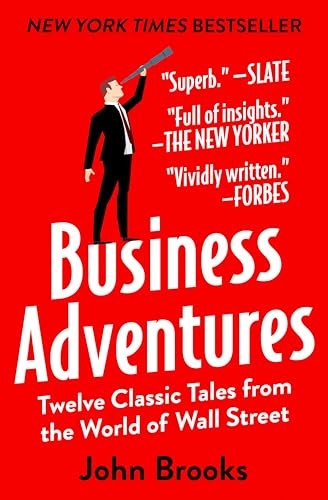
⚡️ What is Business Adventures about?
Business Adventures is a collection of twelve classic, meticulously reported narratives from the world of Wall Street and corporate America, originally penned by John Brooks for *The New Yorker*. Championed by both Bill Gates and Warren Buffett as the best business book they’ve ever read, it’s not a manual of modern tactics but a deep dive into the timeless human dramas that shape the business world. The book explores monumental successes and catastrophic failures, from the Ford Edsel disaster to the Xerox revolution. Each story is a case study in corporate strategy, market psychology, and the often-unpredictable nature of human ambition. Reading Business Adventures feels less like studying and more like listening to a master storyteller reveal the secrets behind the headlines, offering lessons that remain profoundly relevant decades later.
🚀 The Book in 3 Sentences
- Business Adventures reveals that the fundamental principles of business and human nature are unchanging, regardless of technological or market evolution.
- Through compelling true stories, the book illustrates that success often hinges on a fragile mix of innovation, timing, corporate culture, and sheer luck.
- The ultimate lesson is that understanding the past is the best way to navigate the unpredictable future of the corporate world.
🎨 Impressions
>My impression of Business Adventures is one of sheer admiration for its storytelling prowess. Unlike modern business books that often present prescriptive formulas, this book immerses you in the narrative, allowing you to draw your own conclusions from the events as they unfold. Brooks’s writing is elegant, detailed, and surprisingly witty, making complex financial events feel like gripping dramas. What struck me most was the timelessness of the human elements: greed, fear, ego, and integrity are the true drivers of the stories. It’s a refreshing reminder that behind every stock ticker and corporate balance sheet are people making fateful decisions. The book feels less like a historical artifact and more like a collection of cautionary and inspirational tales for any modern professional.📖 Who Should Read Business Adventures?
>This book is essential reading for entrepreneurs, business leaders, investors, and anyone fascinated by the intersection of commerce and human behavior. If you’re tired of fleeting business trends and seek to understand the fundamental, unchanging dynamics of the market, Business Adventures is for you. Business students will find more value in these real-world case studies than in many textbooks. It’s also perfect for history buffs who enjoy seeing how pivotal moments unfolded. Ultimately, anyone who wants to move beyond surface-level analysis and grasp the deep, often messy, reality of how business works will find this book incredibly rewarding.☘️ How the Book Changed Me
>Reading Business Adventures- I now view corporate crises not just as failures but as critical tests of character and leadership, much like the American Express salad oil scandal detailed in the book.
- The story of the Edsel taught me to be incredibly wary of ignoring market research, no matter how strong an internal “hunch” feels.
- I’ve gained a long-term view, understanding that today’s disruptive technology is tomorrow’s baseline, a lesson powerfully illustrated by the Xerox story.
✍️ My Top 3 Quotes
- “The stock market is a story of cycles, and it has taught me that the greatest opportunities arise in times of maximum pessimism.”
- “The consumer is the dictator without peer.” – Wall Street Journal on the Ford Edsel
- “What makes a good business book? In my view, it’s one that gives you a framework for looking at the world. John Brooks’s work does that brilliantly.” – Bill Gates
📒 Summary + Notes
Business Adventures is structured as a series of twelve standalone articles, each a deep dive into a specific event or company from the mid-20th century. While the settings may seem dated, the underlying lessons on corporate behavior, market psychology, and ethical dilemmas are eternal. The book’s power lies in its narrative approach; it doesn’t preach but rather shows, allowing readers to experience the tension, drama, and consequences of each business adventure. From catastrophic product launches to brilliant innovations and audacious financial schemes, these stories provide a rich education in the realities of the business world that no textbook could replicate.
Chapter 1: The Fluctuation
This chapter dissects the sudden and severe stock market crash of May 1962, a event less famous than 1929 but equally terrifying at the time. Brooks explores the panic, the confusion, and the search for a culprit. The surprising post-mortem suggested the crash wasn’t triggered by big institutions but by a wave of selling from unexpected sources: small, individual investors, particularly rural women. The chapter highlights how market dynamics can be counter-intuitive and how stability was eventually restored not by grand gestures but by the steady buying of mutual funds, a new force in the market at the time.
- Market crashes can have unpredictable and non-obvious triggers.
- The psychology of panic selling is a powerful, and often irrational, market force.
- New market players (like mutual funds in the ’60s) can act as unexpected stabilizers.
Chapter 2: The Fate of the Edsel
Perhaps the most famous chapter, this is the definitive account of Ford’s monumental Edsel failure. Brooks details the immense hubris, quarter-billion-dollar investment, and years of hype that preceded the car’s launch. He masterfully breaks down the reasons for its flop, including the disastrous choice of name (ignored market research), a design that was arrived at by committee “hunches” rather than customer input, and a launch during a shifting market trend towards smaller cars. The Edsel became a synonym for commercial failure, a powerful lesson in the dangers of arrogance and the supreme authority of the consumer.
- Extensive market research is useless if its conclusions are ignored by leadership.
- A product name can have a significant impact on its perception and success.
- Timing is critical; launching a product for a market that no longer exists is a recipe for disaster.
- Internal company culture and overconfidence can blind a company to reality.
Chapter 3: The Federal Income Tax
This chapter is a surprisingly engaging history of the U.S. federal income tax. Brooks traces its origins, its evolution, and the complex, often absurd, loopholes and regulations that have developed over time. He profiles the characters involved in shaping tax policy and the relentless efforts of citizens and corporations to minimize their tax burden. The story serves as a fascinating look at the interplay between government policy and economic behavior, showing how the tax code has become a reflection of American values, politics, and the eternal struggle between public funding and private interests.
- Tax policy is a powerful tool that can shape both corporate and individual behavior.
- The complexity of the tax code is a direct result of political compromise and special interests.
- Understanding the history of tax policy provides crucial context for today’s economic debates.
Chapter 4: A Reasonable Amount of Time
This chapter tells the story of Clarence Saunders, the eccentric founder of the Piggly Wiggly supermarket chain, and his audacious attempt to corner the market on his own company’s stock in the 1920s. It’s a classic tale of ego, ambition, and the perils of over-leverage. Saunders’s public battle with Wall Street speculators and the New York Stock Exchange is a gripping drama. Ultimately, his gamble failed spectacularly, leading to his ruin. The story is a timeless cautionary tale about the dangers of believing you can outsmart the market and the importance of humility in finance.
- Ego is one of the most dangerous forces in investment and business.
- Attempting to manipulate the market, even in your own stock, is incredibly risky.
- The story highlights the power and established rules of major financial exchanges.
Chapter 5: Xerox Xerox Xerox Xerox
In stark contrast to the Edsel, this chapter charts the phenomenal success of Xerox. Brooks details the invention of the xerographic copier by Chester Carlson and the long, difficult journey to bring it to market. He explains how Xerox created a 10x improvement in copying technology, making competitors obsolete. The chapter also praises Xerox’s surprisingly progressive corporate culture for its time, including its “one-per-cent” program for community donations and its stance on social issues. It’s a story of perseverance, technological breakthrough, and building a company with both a powerful product and a conscience.
- True market disruption comes from creating a product that is dramatically better, not just incrementally.
- Corporate social responsibility can be a powerful asset for building a brand’s reputation.
- Patience and long-term investment are often required to bring a revolutionary technology to market.
Chapter 6: Making the Customers Whole
This chapter details the 1963 American Express salad oil scandal, where a commodities dealer defrauded the company by using fake inventory as loan collateral. The scandal threatened to bankrupt Amex, as its stock plummeted and the liability was unclear. Brooks focuses on the masterful crisis management by CEO Howard Clark. Instead of shirking responsibility, Amex took the extraordinary step of offering to make all its customers who had accepted the fraudulent paper “whole,” spending millions to protect public trust. This decision, though costly, saved the company’s reputation and is a legendary case study in putting customer relationships above short-term profit.
- In a crisis, protecting customer trust is the most important long-term strategy.
- Strong, decisive leadership is essential to navigate corporate scandals.
- A company’s reputation is one of its most valuable and fragile assets.
Chapter 7: The Impacted Philosophers
This chapter delves into a seemingly obscure antitrust case against a small group of economists who were advising corporations. Brooks uses this legal battle to explore the complex and often contradictory world of antitrust law. The “impacted philosophers” were accused of conspiracy for simply sharing their expertise. The story is a fascinating look at the intersection of economic theory, law, and government regulation. It highlights how the application of justice can sometimes be strange and how the lines between academic thought and business practice can become dangerously blurred.
- Antitrust law can be applied in unpredictable and sometimes illogical ways.
- The line between consulting and collusion can be perilously thin.
- This story serves as a reminder of the regulatory risks that businesses must navigate.
Chapter 8: The Last Great Corner
Here, Brooks recounts the 1960s attempt by a group of Texas investors to corner the market in Texas Gulf Sulphur stock. The story is a thrilling account of insider trading, greed, and the cat-and-mouse game between the cornerers and the SEC. It details how the group used inside information about a major mineral discovery to secretly accumulate a massive position. The eventual fallout led to landmark legal decisions that clarified the definition of illegal insider trading. It’s a classic Wall Street drama that shows how the game is played and, sometimes, how the players get caught.
- Insider trading has been a persistent challenge in maintaining market fairness.
- Regulatory bodies like the SEC play a crucial role in policing market manipulation.
- The story was instrumental in shaping modern securities law.
Chapter 9: A Second Sort of Life
This chapter offers a biographical portrait of David Lilienthal, a unique figure who successfully transitioned from being the head of a major government agency (the Tennessee Valley Authority and the Atomic Energy Commission) to a top executive in the private sector. Brooks explores the challenges and adjustments required for such a move. The story is a thoughtful reflection on public service versus private enterprise, leadership styles, and the different skills needed to succeed in each world. It’s a more character-driven piece that examines the life of a man who shaped 20th-century America in two very different arenas.
- Transitioning from public leadership to a corporate role requires a significant shift in mindset and skills.
- Effective leadership principles can be applied across different sectors, but the context is crucial.
- The story provides insight into the relationship between government and big business in post-war America.
Chapter 10: The Stockholder Meeting
With a humorous and keen eye, Brooks examines the peculiar ritual of the annual corporate stockholder meeting. He describes how companies in the 1960s began holding these meetings in remote locations to avoid confrontational urban investors. The chapter is a collection of vignettes from various meetings, showcasing the often-theatrical interactions between corporate executives and their shareholders. It’s a revealing look at corporate governance, public relations, and the delicate balance of power between a company’s management and its owners. The antics and questions from the floor highlight the democratic, and sometimes chaotic, nature of corporate ownership.
- Stockholder meetings are as much about public relations and theater as they are about corporate business.
- Corporate executives must be skilled communicators to handle a diverse and sometimes hostile audience of shareholders.
- The location of a meeting can be a strategic decision to control the narrative.
Chapter 11: One Free Bite
This chapter focuses on a small, family-run New York brokerage firm that was charged with violations by the SEC. The title refers to the legal principle that everyone deserves “one free bite” before being punished for a minor transgression. Brooks uses this seemingly minor case to explore the culture of Wall Street regulation, the nature of justice, and the difference between a technical violation and malicious intent. It’s a nuanced story that questions whether rigid rules are always fairly applied and shows the immense pressure that regulatory bodies can exert on even the smallest players in the financial world.
- The legal system often grapples with the line between intent and technical violation.
- Small businesses can be disproportionately affected by complex financial regulations.
- The story provides a human face to the often-impersonal world of financial regulation.
Chapter 12: In Defense of Sterling Green
The final chapter is a poignant and personal story about a man named Sterling Green who was convicted of fraud in a questionable case. Brooks delves into Green’s background and the details of his trial, building a compelling case for his innocence. The chapter is a powerful meditation on justice, reputation, and the devastating impact a wrongful conviction can have on a person’s life. It serves as a somber conclusion to the book, reminding us that behind the financial figures and corporate dramas are real human lives, and that the systems we build are not always perfect or just.
- A person’s reputation is incredibly fragile and difficult to restore once damaged.
- The justice system, like any human institution, is fallible.
- This chapter leaves the reader with a profound sense of empathy and the human cost of business and legal failures.
Key Takeaways
The lessons from Business Adventures are not step-by-step instructions but profound principles for navigating the corporate world. The book teaches that while technology and markets change, the core drivers of human behavior—greed, fear, ambition, and integrity—remain constant. Success is never guaranteed, and failure often comes from a combination of hubris, poor timing, and a disconnect from reality. The most resilient companies are those that build trust, adapt to change, and maintain a strong ethical compass. These stories are the ultimate Business Adventures strategies, offering a masterclass in corporate decision-making.
- Human nature is the most predictable, and powerful, force in business and markets.
- Never ignore your customers; their collective will is the ultimate arbiter of success or failure.
- A company’s reputation is an invaluable asset that must be protected, especially during a crisis.
- Ego and overconfidence are the silent killers of many promising ventures.
- Understanding history provides the best framework for making sense of the present and anticipating the future.
Conclusion
In conclusion, Business Adventures is more than just a collection of old business stories; it’s a timeless education in the fundamentals of commerce and human behavior. John Brooks’s masterful storytelling turns case studies into compelling dramas that offer profound insights into why companies succeed and fail. The book’s enduring appeal, as endorsed by icons like Gates and Buffett, lies in its focus on the unchanging character of the people behind the profit and loss statements. For anyone seeking to deepen their understanding of business beyond fleeting trends and buzzwords, this book is an indispensable read. It provides the kind of wisdom that can only be gained by looking back, making it an essential guide for the Business Adventures of tomorrow.
More From John Brooks →
Discover more from AI Book Summary
Subscribe to get the latest posts sent to your email.