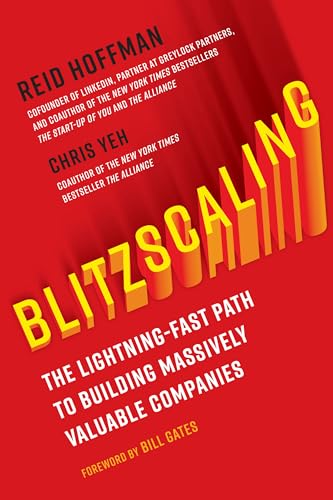
⚡️ What is Blitzscaling about?
Blitzscaling Book Summary explores a high-risk, high-reward growth strategy where companies prioritize lightning-fast expansion over efficiency amid uncertainty. Reid Hoffman and Chris Yeh reveal how tech giants like LinkedIn, Airbnb, and Google achieved massive valuations by deliberately embracing chaos, launching imperfect products, and ignoring certain customer complaints to capture markets before competitors. This approach is vital in industries with strong network effects where ‘first-scaler advantage’ creates unbeatable moats. The book provides actionable frameworks for when to blitzscale, how to innovate business models, and critical management transitions required at each growth stage – all while acknowledging the strategy’s inherent dangers including potential financial waste and organizational instability.
🚀 The Book in 3 Sentences
- Blitzscaling Book Summary defines the strategy of prioritizing speed over efficiency when capturing a massive market opportunity with positive network effects and high competitive threat.
- Successful blitzscaling requires three pillars: business model innovation (viral distribution + high margins), strategy innovation (first-scaler advantage), and management innovation (hiring “Ms. Right Now” executives).
- Companies must navigate five growth stages from Family to Nation while making counterintuitive choices like launching embarrassing products and tolerating “bad” management to achieve exponential growth.
🎨 Impressions
This Blitzscaling Book Summary delivers unparalleled strategic depth for scaling ventures, though its density demands careful study. Hoffman and Yeh brilliantly demystify how companies like PayPal and YouTube achieved explosive growth through deliberate chaos – a revelation for entrepreneurs stuck in traditional efficiency mindsets. The framework’s brilliance lies in its actionable transition matrices between growth stages, though the relentless focus on speed occasionally downplays ethical implications. As a practitioner, I found the ‘nine counterintuitive rules’ section transformative, especially the permission to ‘let fires burn’ when prioritizing existential threats. While occasionally Silicon Valley-centric, this remains the definitive playbook for building category-dominant companies in winner-take-all markets.
📖 Who Should Read Blitzscaling?
Entrepreneurs building tech platforms with viral potential, VC investors evaluating scaling trajectories, and corporate innovation leaders launching disruptive ventures should devour this Blitzscaling Book Summary. Founders in markets with strong network effects – marketplaces, social networks, or platforms – will gain critical insights to avoid the ‘growth plateau’ that kills promising startups. Incumbent executives seeking to revitalize legacy businesses will learn how to structure ‘company within a company’ initiatives. However, traditional business managers seeking operational efficiency playbooks should look elsewhere; this is strictly for those pursuing category dominance through aggressive capital deployment and controlled chaos. The frameworks prove invaluable for anyone navigating hypercompetitive markets where being first to scale creates unassailable advantages.
☘️ How the Book Changed Me
Reading this Blitzscaling Book Summary fundamentally reshaped my approach to startup growth metrics and team development. I now actively identify ‘first-scaler advantages’ in new ventures rather than optimizing prematurely for profitability, recognizing that misdiagnosing blitzscaling opportunities wastes irreplaceable market windows.
- I stopped obsessing over product perfection after realizing ‘launching embarrassing products’ accelerates learning cycles more effectively than delayed ‘perfect’ launches
- I redesigned my hiring matrix to prioritize ‘Ms. Right Now’ candidates who thrive in chaos at current scaling stage versus ‘ideal’ candidates for future stages
- I implemented the ‘Maslovian hierarchy of fires’ framework to triage crises, focusing only on distribution and revenue model fires while letting operational fires burn temporarily
✍️ My Top 3 Quotes
- ‘Blitzscaling is prioritizing speed over efficiency in the face of uncertainty – when you must move faster than common sense dictates to win a massive market.’
- ‘If you need to choose between getting to market quickly with an imperfect product or slowly with a “perfect” product, choose the imperfect product nearly every time.’
- ‘Culture is heavily determined by who you hire, promote, and fire. Ignoring your culture is not an option.’
📒 Summary + Notes
This Blitzscaling Book Summary crystallizes a decade of Silicon Valley’s hardest-won scaling lessons into an actionable playbook. Hoffman and Yeh argue that traditional business principles fail in winner-take-all markets where capturing mindshare matters more than quarterly profits. The core insight? Blitzscaling is intentionally wasteful – burning cash to achieve distribution velocity while competitors remain complacent. Crucially, the strategy only works when four conditions exist: massive market size, viral distribution, strong unit economics at scale, and network effects. Throughout this summary, we’ll dissect how companies like Uber leveraged ‘pirate metrics’ for explosive growth while navigating the eight critical management transitions between scaling stages. What separates Blitzscaling from reckless growth is its structured chaos framework – knowing precisely which fires to ignore to conserve energy for existential threats.
Chapter 1: What Is Blitzscaling?
Hoffman defines blitzscaling as ‘prioritizing speed over efficiency amid uncertainty’ – a deliberate tradeoff where acceptable waste accelerates market dominance. Unlike sustainable scaling, blitzscaling requires massive capital injections to overcome coordination costs in hypergrowth phases. The chapter establishes four prerequisites: massive addressable market (>10x current size), compelling business model innovation (viral loops + high margins), strong network effects, and high competitive threat. Crucially, blitzscaling isn’t universal – it fails in regulated industries or markets without scale advantages. Hoffman illustrates with PayPal’s early days where burning $10M annually to subsidize user growth created unbeatable network effects that crushed competitors.
- Key insight: Speed becomes the ultimate moat when network effects dominate your market
- Real example: LinkedIn’s ‘People You May Know’ feature generated explosive growth through algorithmic virality
- Practical application: Map your market’s ‘first-scaler advantage’ potential before committing capital
Chapter 2: Business Model Innovation
This chapter dissects how blitzscalers engineer growth through structural advantages rather than product superiority. Hoffman identifies four growth accelerators: massive market size (>1B potential), viral distribution (organic user acquisition), high gross margins (>60% at scale), and powerful network effects. Crucially, ‘bits not atoms’ digital businesses dominate because marginal costs approach zero. The authors detail five network effect types – direct (Facebook), indirect (iOS apps), two-sided (eBay), local (cellular plans), and compatibility (Microsoft Office). They stress that ‘nonobvious opportunities’ arise from market shifts incumbents ignore, like how WhatsApp exploited smartphone adoption while telcos focused on voice plans.
- Key insight: Freemium models create viral distribution loops when free users recruit paying users
- Real example: Facebook’s News Feed created direct network effects that accelerated engagement 3x
- Practical application: Calculate ‘viral coefficient’ – if >1, your growth becomes self-sustaining
Chapter 3: Strategy Innovation
Hoffman argues blitzscaling timing is strategic, not opportunistic. Four triggers signal readiness: massive new opportunity (smartphone revolution), first-scaler advantage (network effects), steep learning curves (AI training data), and imminent competition. The chapter introduces the ‘five stages of scale’ framework: Family (founder-driven), Tribe (managed teams), Village (departmentalized), City (divisional), and Nation (conglomerate). Each stage requires different leadership approaches – founders must evolve from ‘doers’ to ‘designers’ of systems. Crucially, successful blitzscalers use ‘leading indicators’ like declining growth velocity (vs market) to trigger transitions before crises hit, as seen when Netflix shifted from DVDs to streaming during peak DVD profitability.
- Key insight: Blitzscaling is iterative – ‘do things that don’t scale’ to reach next stage
- Real example: Google’s ‘20% time’ policy created organic innovation during Tribe-to-Village transition
- Practical application: Track per-employee productivity – when it plateaus, you’ve outgrown current structure
Chapter 4: Management Innovation
This vital chapter details eight counterintuitive management transitions during blitzscaling. Founders must shift from small generalist teams to specialized departments, from contributor to executive leadership roles, and from inspirational storytelling to data-driven broadcasting. Hoffman emphasizes hiring ‘just right’ managers for current stages – a $100M-revenue startup needs different leaders than a $1B company. The chapter’s ‘nine counterintuitive rules’ include tolerating ‘bad’ management (until it becomes toxic), embracing chaos through multiple contingency plans, and intentionally ignoring customers to conserve energy for strategic fires. Crucially, culture must evolve deliberately through hiring/promotion decisions – as Airbnb scaled, they formalized culture carriers to maintain core values during hypergrowth.
- Key insight: ‘Ms. Right Now’ hires thrive in current chaos rather than ‘perfect’ future-fit candidates
- Real example: LinkedIn’s Merlin system analyzed sales data to personalize outreach during Tribe stage
- Practical application: Implement ‘Maslovian fire hierarchy’ – prioritize distribution fires over customer complaints
Chapter 5: Broader Landscape of Blitzscaling
Hoffman analyzes how established companies can blitzscale despite structural disadvantages. While incumbents possess scale advantages and acquisition capabilities, they suffer from misaligned incentives (quarterly earnings pressure), unstaged commitments (all-or-nothing bets), and public market constraints. The chapter details three defensive strategies against blitzscalers: beat them (copycat features), join them (acquire competitors), or avoid them (wait for collapse). For corporate innovators, key tactics include creating ‘companies within companies’ with separate P&Ls, leveraging VC partnerships for external innovation, and staging investments through pilot phases. Microsoft’s successful blitzscaling of Azure demonstrates how leveraging existing enterprise relationships can overcome typical incumbent inertia through careful organizational separation.
- Key insight: Incumbents must decouple new ventures from legacy incentive structures
- Real example: Amazon created separate leadership principles for AWS during its blitzscaling phase
- Practical application: Use ‘red teaming’ exercises to identify disruptive threats – ‘If we were attacking ourselves, how would we do it?’
Chapter 6: Responsible Blitzscaling
The concluding chapter confronts blitzscaling’s ethical dimensions. Hoffman argues blitzscalers bear societal responsibilities beyond shareholder returns – from ensuring worker safety (Uber driver protections) to preventing democratic erosion (Facebook’s engagement algorithms). He introduces the ‘responsibility spectrum’ where companies must proactively address externalities like misinformation or monopolistic behavior. The framework includes four action areas: designing for positive network effects (avoiding addiction traps), implementing transparency protocols, engaging regulators early, and building ‘responsibility into the product’. Crucially, Hoffman acknowledges past failures (like rapid Airbnb expansion displacing communities) while providing concrete tools for balancing growth with social impact – exemplified by Stripe’s climate-focused blitzscaling initiatives using carbon removal credits.
- Key insight: Unchecked network effects can amplify societal harms as quickly as value
- Real example: Twitter’s algorithmic amplification of hate speech during growth phase
- Practical application: Conduct ‘responsibility stress tests’ before major scaling decisions
Key Takeaways
The Blitzscaling Book Summary delivers actionable wisdom for dominating winner-take-all markets through calculated velocity. Most critically, blitzscaling isn’t about reckless growth but strategic acceleration where speed creates insurmountable advantages. The frameworks provide precise diagnostics for when this high-risk approach applies – primarily in digital markets with strong network effects and massive scalability. Founders must master the art of ‘controlled chaos’ through counterintuitive moves like launching embarrassing products and ignoring customer complaints to conserve energy for existential threats. However, the most transformative insight is recognizing that management systems must evolve faster than the business itself, with leadership transitions being the most frequent point of failure during hypergrowth.
- Blitzscale only when four conditions align: massive market, viral distribution, network effects, and high competition
- Implement the nine counterintuitive rules – especially ‘hire Ms. Right Now’ and ‘let fires burn’
- Evolve management structures through the five growth stages before hitting plateaus
- Build ‘responsibility into the product’ to mitigate societal harms during hypergrowth
Conclusion
This Blitzscaling Book Summary crystallizes the most powerful growth strategy of the digital age – transforming abstract concepts into executable playbooks for market domination. While not without risks (capital waste, culture collapse), the framework provides invaluable guardrails for navigating hypergrowth’s inherent chaos. For entrepreneurs in scalable markets, these blitzscaling strategies separate category kings from also-rans; for corporate innovators, they offer survival tools against digital disruption. Implement the management transition matrices and counterintuitive rules immediately, but always pair velocity with responsibility – as Hoffman warns, ‘the companies that endure are those that balance growth with societal impact.’ If you’re building in a networked market, studying the original Blitzscaling Book Summary isn’t optional; it’s your strategic survival kit in today’s winner-take-all economy.
More From Reid Hoffman; Chris Yeh →
Discover more from AI Book Summary
Subscribe to get the latest posts sent to your email.