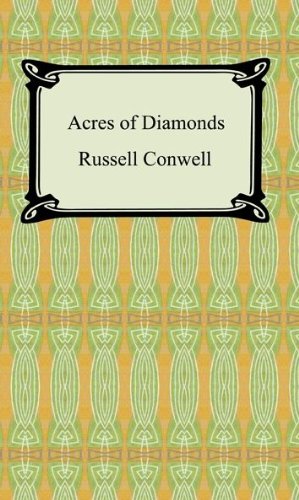
⚡️ What is Acres of Diamonds About?
I finished reading this book last week and, honestly, it’s like a slap in the face for anyone currently suffering from ‘shiny object syndrome.’ Originally delivered as a lecture over 6,000 times by its author, More summaries by Russell Conwell presents a simple, jarring thesis: the greatness you’re looking for isn’t in another city, another job, or another industry. It’s right where you are standing.
Conwell, who founded Temple University using the proceeds from this very speech, isn’t just selling platitudes. He’s obsessed with the idea of local opportunity and the moral duty to be successful. As I waded through these self-help book summaries, I realized that while the language is dated (it was first published in 1890), the psychological trap it describes—the belief that success is ‘somewhere else’—is more prevalent now in our hyper-connected world than it ever was in the 19th century.
🚀 The Book in 3 Sentences
- The vast majority of people fail because they spend their lives looking for ‘diamond mines’ in distant lands while overlooking the literal riches buried in their own property.
- True wealth is found by identifying a specific, local need and filling it better than anyone else, rather than chasing abstract or far-flung dreams.
- Success is a matter of intelligent observation; you must learn to see ‘rough diamonds’ as they appear in nature—dirty and unpolished—rather than waiting for them to look like jewelry.
🎨 Impressions
Reading this felt like sitting in a dusty Victorian lecture hall while a guy with a booming voice tells you to stop complaining about your paycheck. It’s incredibly direct. Conwell doesn’t mince words—he actually argues that it’s your *duty* to get rich because you can do more good with money than without it. That part made me pause. We’ve been conditioned to think of ‘wanting money’ as greedy, but Conwell frames it as a form of service. If you’re rich, it’s because you’ve solved problems for a lot of people.
What frustrated me, though, was the relentless optimism. Conwell makes it sound like anyone who isn’t wealthy is simply unobservant or lazy. Is that always true? I don’t think so. But his core point about ‘acres of diamonds’—that we ignore the resources we already have—is something I’ve seen play out in my own life a dozen times. We’re all looking for the next big thing, while the ‘small’ thing right in front of us is actually the foundation of a kingdom. It’s a convicting read, even if it feels a bit ‘pull-yourself-up-by-your-bootstraps’ at times.
📖 Who Should Read Acres of Diamonds?
If you’re an entrepreneur who keeps jumping from one ‘hot’ niche to another, you need this. It’s also perfect for anyone feeling stuck in a ‘boring’ town or ‘dead-end’ job; it’ll force you to look at your surroundings with fresh eyes. However, if you’re looking for a systemic critique of capitalism or a nuanced take on socio-economic barriers, you won’t find it here. This is a book for the individual who wants to take 100% responsibility for their outcomes.
☘️ How This Book Changed My Thinking
Before reading this, I was always looking ‘out there’ for my next project—new markets, new tools, new connections. After sitting with Conwell’s argument, I realized I hadn’t even fully utilized the people I already know or the skills I’ve already half-mastered.
- I stopped looking for ‘new’ business ideas and started asking my current clients what else they were struggling with that I was ignoring.
- I realized that ‘opportunity’ usually looks like a mess or a problem, not a finished product.
- I committed to becoming a ‘first-class professional’ in my current niche instead of being a ‘third-class’ amateur in five different ones.
✍️ 3 Quotes That Stuck With Me
- “Greatness consists in doing some great deed with little means.” — This reminds me that I don’t need a massive VC check to start something meaningful.
- “I say you ought to be rich, and it is your duty to get rich.” — A total 180-degree turn from the modern ‘money is evil’ narrative.
- “He who can give to this city better streets… or better schools, or more recreation, will be a benefactor to his kind.” — This highlights the idea that wealth is a byproduct of local service.
📒 Summary + Notes
The narrative of the book follows a very specific arc: it starts with a cautionary tale and moves into a philosophical mandate for local action. Conwell’s goal is to convince you that your current environment is a goldmine, provided you have the eyes to see it. He uses the story of Ali Hafed—a man who sold his farm to find diamonds and died penniless, only for the new owner to find the world’s greatest diamond mine on that very land—as a permanent metaphor for the human condition. We are all Ali Hafed until we decide to dig where we stand.
The second half of the book is essentially a manual on ‘market research’ before that term existed. Conwell tells stories of inventors and merchants who became millionaires by simply noticing what their neighbors needed. He argues that ‘greatness’ isn’t about being famous; it’s about being useful. By the end, he wants you to believe that the only thing standing between you and wealth is your refusal to take an interest in the people and resources currently within your reach.
1: The Story of Ali Hafed
Why do we always think the diamond mine is in the next country over? Conwell opens with the story of a Persian farmer named Ali Hafed who was wealthy and contented until a priest told him about the glory of diamonds. Suddenly, his wealth felt like poverty. He sold his farm and traveled the world searching for these stones, eventually drowning himself in despair when he found nothing.
But here is the kicker: the man who bought Ali Hafed’s farm led his camel to the garden brook one day and noticed a flash of light in the white sands. He’d found the diamond mines of Golconda. The very farm Ali Hafed sold to go looking for diamonds was literally made of them. Are you currently ‘selling’ your time or your potential to look for something that is already in your backyard?
2: The Duty to be Rich
Do you believe that money is the root of all evil? Conwell argues the exact opposite. He claims that to be poor is a misfortune, and to remain poor when you have the capacity to be rich is a failure of character. It’s a jarring chapter, especially for those of us raised on the idea that ‘pious poverty’ is a virtue.
- Money is power, and you can do more for your church, your community, and your family with it.
- Ninety-eight out of one hundred rich men are honest; that is why they are trusted with money.
- The desire to be wealthy is simply the desire to have a larger influence for good.
3: The Power of Observation
What does a diamond look like in its rough state? Conwell points out that Ali Hafed didn’t know what a diamond looked like in the ground—he only knew what a polished one looked like in a crown. This is why we miss opportunities. We’re looking for the finished, polished success story, but the opportunity itself usually looks like a common rock or a messy problem.
He tells the story of a man who worked in a tannery and thought there was no future in it. He left to study to become a minister. Meanwhile, the man who stayed in the tannery noticed a specific way to process the hides that everyone else ignored. That man became a multi-millionaire. The lesson? You don’t need a new industry; you need better eyes for the one you’re in.
4: Success Is a Local Business
Is your neighborhood really as ‘barren’ as you think? Conwell challenges the reader to go out and ask their neighbors what they need. He argues that every great business started by solving a small, local problem. If you can’t find a way to be successful in your current town, moving to New York or London won’t help you. The fundamentals of human need are the same everywhere.
He shares examples of people who invented simple things—like a better hat pin or a specific type of toy—just by watching their own children or wives struggle with a problem. These weren’t ‘geniuses’; they were just people who stopped ignoring the ‘small’ irritations of daily life. Have you ever stopped to ask why a certain thing in your town is ‘always done that way’?
5: The Foundation of Greatness
What makes a person ‘great’? Conwell concludes that greatness isn’t about office or title. It’s about the scale of your service. He tells the story of a simple man who helped his community and was loved by all, contrasting him with ‘great’ men who were miserable and lonely.
To be truly great, you must be truly small first. You must be willing to do the humble work of observing, serving, and building right where you are. The ‘acres of diamonds’ aren’t just about money; they’re about the richness of a life lived in full engagement with your immediate world. It’s a call to presence as much as it is a call to profit.
⚖️ A Critical Perspective
While the core message is timeless, the book suffers from extreme survivorship bias. Conwell tells us about the one man who stayed in the tannery and got rich, but he doesn’t mention the thousands who stayed and died in poverty despite their best efforts. He also tends to equate wealth with virtue in a way that feels a bit ‘Prosperity Gospel-ish.’ In 2025, we know that systemic issues—like access to capital, education, and healthcare—play a massive role in success that ‘observation’ alone can’t always fix. It’s a great kick in the pants, but it shouldn’t be your only map for navigating the modern economy.
🔄 How It Compares
If you’ve read The Alchemist by Paulo Coelho, you’ll recognize the theme of traveling the world only to find the treasure back home. However, while The Alchemist is a mystical, fictional journey about ‘Personal Legends,’ Acres of Diamonds is a gritty, practical, and highly capitalist demand to start a business and serve your neighbors. One is for the soul; the other is for the wallet.
🔑 Key Takeaways
If you want to start mining your own life for riches, keep these four lessons in mind:
- **Audit your backyard:** List every resource, contact, and skill you currently possess before looking for new ones.
- **Look for the ‘rough’ state:** Stop waiting for a perfect opportunity; look for a problem that needs a messy solution.
- **Serve locally:** Wealth is a direct reflection of how many people you help in your immediate vicinity.
- **Obsess over details:** The difference between a common rock and a diamond is often just a bit of specialized knowledge.
💬 Frequently Asked Questions
What is the main message of Acres of Diamonds?
The core argument is that opportunity is not something you go ‘find’ in a distant place or a new career. Instead, success is found by identifying and solving the problems of the people right in front of you using the resources you already have at your disposal.
Who was Ali Hafed in the book?
Ali Hafed is the central character of the book’s opening parable. He was a wealthy farmer who sold everything to search for diamonds elsewhere, only to die in poverty. Ironically, his original farm turned out to be the richest diamond mine in history, discovered by his successor.
Does Russell Conwell believe that being poor is a sin?
Conwell argues that while being poor isn’t a sin in itself, staying poor when you have the health and opportunity to be wealthy is a failure. He believes money is a tool for good and that achieving wealth through honest service is a moral duty.
Is the story in Acres of Diamonds true?
The story of the Golconda diamond mines is based on historical fact, though Conwell’s specific retelling of Ali Hafed is a parable he heard from an Arab guide. It is used as a rhetorical device to illustrate the universal tendency to overlook local opportunities.
How can I apply Acres of Diamonds to my career today?
Start by becoming a ‘first-class professional’ in your current role. Instead of looking for a new job, look for ways to provide more value to your current employer or customers. Ask yourself what local problem everyone else is ignoring and solve it.
Conclusion
At its heart, Acres of Diamonds is a cure for the chronic restlessness that plagues so many of us. We are constantly told that ‘disruption’ and ‘innovation’ happen elsewhere—in Silicon Valley, in high-tech labs, or in distant markets. Conwell reminds us that the human heart and its needs are the same everywhere. If you can find a way to be more useful to the person standing next to you, you have found your diamond mine.
Don’t be like Ali Hafed. Don’t spend your life wandering the world looking for a flash of light that is already glimmering in your own garden brook. Take the time to study what you have, serve who you know, and dig where you stand. You might just find that your own backyard is far richer than you ever imagined. If you enjoyed this perspective, check out more self-help book summaries on our site to keep the momentum going.
More From Russell Conwell →
Discover more from AI Book Summary
Subscribe to get the latest posts sent to your email.