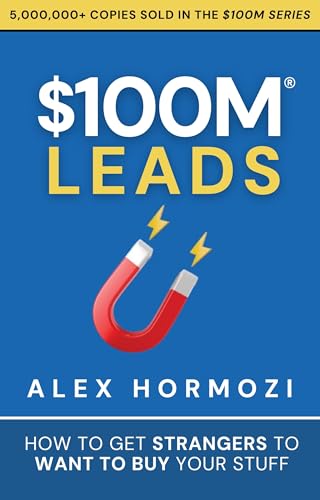
⚡️ What is $100M Leads About?
Ever feel like you have a world-class product but nobody’s knocking on your door? It’s a soul-crushing spot to be in. Alex Hormozi wrote $100M Leads because he’s been there—broke, sleeping on gym floors, and wondering why the phone wasn’t ringing. He argues that getting leads is the ultimate “get out of jail free card” for any entrepreneur. If you can get people to notice you and want what you have, you’re never truly broke. You just have a math problem to solve.
The central thesis is that there are only four ways to get leads yourself (The Core Four) and four ways to get other people to do it for you. It’s a blue-collar approach to high-level marketing. No fancy jargon or “branding” fluff. Just raw volume, better hooks, and the persistence to survive the learning curve. I’ve read a lot of marketing book summaries, but few are this brutally honest about how much it actually sucks to get started. You can also find more summaries by Alex Hormozi if you’re looking to master the offer side of the equation first.
🚀 The Book in 3 Sentences
- A lead is just a person you can contact, and your business’s value is directly tied to the size and quality of the list of people who want to buy from you.
- The “Core Four” framework—warm outreach, cold outreach, content, and paid ads—covers every possible way to get a stranger’s attention.
- Success isn’t about finding a “secret” platform; it’s about doing the boring, high-volume work that your competitors are too lazy to finish.
🎨 Impressions
I finished this book last week, and honestly, it felt like getting hit with a cold bucket of reality. While everyone else is talking about “AI-powered automated funnels,” Hormozi is telling you to pick up the phone or record a video that doesn’t suck. I loved the transparency in the paid ads section—he admits he’s lost money more times than he’s made it when starting new campaigns. That’s a refreshing take in an industry where everyone pretends they have a 10x ROAS on day one.
One thing that frustrated me was the sheer scale he operates at. He talks about spending $120k for a few calls with an influencer like it’s a casual Tuesday. If you’re a small business owner, some of the advice on paid ads can feel dangerous if you don’t read the fine print about “expecting to lose money.” But the “How I” vs “How To” content strategy? That’s a nugget of pure gold I started using immediately on my own social channels.
📖 Who Should Read $100M Leads?
If you have a great product but your bank account is stagnant, this is your manual. It’s perfect for service-based entrepreneurs, agency owners, and anyone who isn’t afraid of hard work but is currently working on the wrong things. However, if you’re looking for a “passive income” guide where you set it and forget it, you’ll hate this. This book is for people willing to do 100 reach-outs a day until their thumbs bleed.
☘️ How This Book Changed My Thinking
Before reading this, I thought people had shorter attention spans. Now I realize they just have higher standards. The bar for “good” is just higher now.
- I stopped trying to be an “expert” and started sharing my journey (switching from “How to” to “How I”).
- I realized that if I’m not losing money on some ads, I’m probably not testing enough to find the winners.
- I reframed my lead magnet as a “free gift” that must be so good people would actually pay for it.
✍️ 3 Quotes That Stuck With Me
- “People don’t have shorter attention spans, they have higher standards.” — This killed my excuse for why my content wasn’t performing.
- “I’ve lost money more times than I’ve made money running paid ads.” — A vital reminder that even the pros struggle with the learning curve.
- “The content you create isn’t the compounding asset – the audience is.” — This changed how I view every post I make.
📒 Summary + Notes
Hormozi builds a narrative that leads are the only true constraint to growth. He starts by defining what a lead actually is—someone you can contact—and then moves into the Lead Magnet, which is the value you give away to get that contact info. The rest of the book is a masterclass in distribution. He argues that you don’t need a new platform; you need more volume on the platforms you already have. By the end, he wants you to believe that business is just a game of volume and conversion, and the only way to lose is to stop playing before the math works in your favor.
1: The Problem: No Leads
What happens if your phone never rings? You go out of business. Hormozi explains that most business owners are “starving” because they don’t know how to get strangers to want their stuff. He introduces the idea that leads are the lifeblood of any company. If you can solve the lead problem, you can solve almost any other problem in your business. He frames the entire book as the solution to the “I have no one to sell to” dilemma.
2: The Lead Magnet: Give Before You Ask
You’ve probably been told that “free” is a race to the bottom, but the author argues the opposite. A lead magnet is a small piece of value you give away to get a stranger’s attention. To make it work, it has to solve a specific problem. He lists 11 ways to increase confidence in your offer, such as:
- Proof of previous results
- Volume of happy reviewers
- Specific certifications or third-party endorsements
- A rock-solid guarantee
The goal is to lower the barrier to entry so low that it feels stupid for the lead to say no. Don’t be stingy with your best stuff—if the free gift is bad, they’ll assume the paid product is worse.
3: Warm Outreach: The Low Hanging Fruit
Imagine you’re standing in a room full of people who already like you—why aren’t you telling them what you’re doing? Warm outreach is simply contacting the people who already know, like, and trust you. This is the fastest way to get leads because the “trust gap” is already closed. Hormozi emphasizes that you shouldn’t be “salesy” here. Just reach out, provide value, and let them know how you can help. Have you actually told everyone in your phone contacts what your business does lately?
4: Cold Outreach: The Numbers Game
Is there anything more terrifying than calling someone who didn’t ask to be called? Cold outreach is the backbone of many $100M companies, yet most people quit after five rejections. The secret here is 100% volume. You have to reach out to so many people that the “no’s” don’t even register. He breaks down how to personalize at scale and why the first 5 seconds of a cold interaction determine the next 5 minutes. It’s about being human, not a robot following a script.
5: Content: Creating the Audience Asset
There’s a moment early on where Hormozi explains that your content isn’t the asset—the audience is. When you post content, you’re building a long-term relationship with strangers. He gives a massive tip: switch from “How to” to “How I.” Instead of saying “This is the best way to lose weight,” say “This is my favorite way I lost 10 pounds.” It removes the arrogance and makes you relatable. Content is the only way to get leads while you sleep, but it takes the longest to kick in. Are you willing to post for a year without seeing a dime?
6: Paid Ads: Trading Money for Time
Can you really spend $1 to make $3? Hormozi is surprisingly cynical about paid ads for beginners. He warns that you will likely lose money at first. “You won’t be earning; you’ll be learning,” he writes on page 257. He recommends doing paid ads last because the skills you learn in cold outreach and content creation are the exact skills needed to write good ads. If you can’t get someone to click on a free post, they definitely won’t click on an ad you paid for. He also mentions the Facebook stat that the top 0.1% of advertisers test 11x more than everyone else. If you’re not testing, you’re just gambling.
7: Customer Referrals: The Exponential Growth
Why would a customer do your marketing for you? Usually, because you asked—and you gave them a reason. Referrals are the highest quality leads because they come with a pre-built endorsement. Hormozi suggests adding referral triggers at the point of highest excitement (usually right after the purchase). If you can get every customer to bring in 1.1 customers, your business grows forever without you spending another cent on ads.
8: Affiliates: Paying Only for Results
What if you only paid for marketing after you got a sale? That’s the power of affiliates. These are people with their own audiences who promote your stuff for a commission. It’s a zero-risk way to scale, but the challenge is finding and managing the affiliates. You have to treat your affiliates like your customers. Give them the tools, the scripts, and the motivation to sell for you. It’s a relationship business disguised as a marketing channel.
9: Agencies and Employees: Scaling the Effort
Eventually, you run out of hours in the day. This is where you hire others to run the “Core Four” for you. Whether it’s an in-house employee or an external agency, the goal is to buy back your time. However, Hormozi warns against hiring an agency for something you don’t understand. If you don’t know how to get a lead, how will you know if the agency is doing a good job? Master the skill first, then delegate it.
⚖️ A Critical Perspective
While the book is a masterclass in lead generation, the advice on paid ads can be reckless for a small business. Hormozi suggests being willing to lose significant money each month to “learn” the system. For an entrepreneur with $100M, that’s fine; for a local dry cleaner, that’s a one-way ticket to bankruptcy. Additionally, he glosses over the extreme technical complexity of modern ad platforms, suggesting you just “get a consultant.” It’s not always that simple. He also advocates for a 3:1 LTV to CAC ratio, which is standard, but in reality, many industries operate on much thinner margins, making his aggressive spending strategies high-risk for the average reader.
🔄 How It Compares
Compared to Zero to One by Peter Thiel, which focuses on high-level monopoly theory, $100M Leads is a tactical field manual. Thiel wants you to think; Hormozi wants you to work. If Zero to One is about building the right ship, this book is about how to find enough wind to make it move. It’s much closer in spirit to The Closer’s Survival Guide by Grant Cardone, but with a more modern, data-driven framework.
🔑 Key Takeaways
The lessons here are about volume, value, and the relentless pursuit of attention.
- The Rule of 100: Do 100 primary actions a day (100 reach outs, 100 minutes of content, or $100 in ads) to see real results.
- Focus on Hooks: Most people fail not because their product is bad, but because their first 3 seconds don’t grab attention.
- Document, Don’t Create: Share what you are doing (the “How I” method) rather than trying to be a guru.
- The LTV/CAC Ratio: You can’t scale a business if it costs more to get a customer than they are worth to you over their lifetime.
💬 Frequently Asked Questions
What is the difference between $100M Offers and $100M Leads?
$100M Offers is about creating a product that people feel stupid saying no to. $100M Leads is about getting enough people to actually see that offer. You need both to build a big business, but you should generally perfect your offer before you start scaling your lead generation.
What are the ‘Core Four’ in Hormozi’s framework?
The Core Four are the direct ways you get leads: Warm Outreach (friends/family), Cold Outreach (strangers), Posting Content (social media), and Running Paid Ads. Hormozi argues that every successful business on earth uses at least one of these four to find new customers.
Is $100M Leads worth reading for a solo entrepreneur?
Yes, but with a warning. The volume he suggests (The Rule of 100) is incredibly difficult for one person to maintain alongside fulfillment. It’s worth reading for the mindset shift and the “Warm Outreach” tactics, which are the most accessible for someone just starting out alone.
What does Hormozi mean by a ‘Lead Magnet’?
A Lead Magnet is a free gift or service you provide to solve a lead’s specific problem in exchange for their contact information. It acts as a “starter” that builds trust and proves you can actually deliver on your promises before they give you money.
What is the ‘How I’ vs ‘How To’ content strategy?
It’s a shift from being a teacher to being a storyteller. Instead of giving generic advice (How To), you share your personal experience and mistakes (How I). This builds more authority and rapport because you’re showing real-world application rather than just theory.
Conclusion
At the end of the day, $100M Leads is a book about the math of business. Alex Hormozi isn’t promising a magic pill; he’s promising a better shovel. If you’re willing to do the outreach, post the content, and face the rejection, the leads will eventually come. It’s a game of persistence. I walked away realizing that my biggest bottleneck wasn’t my website or my logo—it was just that not enough people knew I existed.
If you take away just one thing from the book, let it be the Rule of 100. Stop overthinking the algorithm and start doing the work. Whether it’s warm calls or daily videos, consistency is the only thing that separates a hobby from a $100M machine. Go check out more marketing book summaries to keep the momentum going, but don’t let the reading be an excuse for not doing the outreach.
More From Alex Hormozi →
Discover more from AI Book Summary
Subscribe to get the latest posts sent to your email.