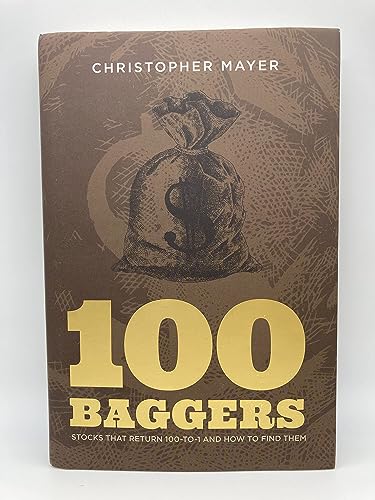
⚡️ What is 100 Baggers About?
Ever wonder what it feels like to turn a measly $10,000 into a cool $1 million? It sounds like the kind of clickbait you’d see on a late-night infomercial, but Christopher W. Mayer argues it’s actually a repeatable, albeit difficult, investment strategy. In this book, Mayer builds on the foundation laid by Thomas Phelps in the 1970s to study the companies that achieved 100-to-1 returns between 1962 and 2014. What he found wasn’t a collection of lucky gambles, but a specific breed of business with identifiable DNA.
I picked this up thinking it would be another dry list of financial ratios, but it’s actually a masterclass in psychological warfare—mostly against your own boredom. Mayer, who you can find more of in my summaries by Christopher W. Mayer, makes the case that the hardest part of investing isn’t finding the winner; it’s refusing to sell it when you’re up 3x or 5x. If you’ve been bouncing between “hot tips” and getting nowhere, these investing book summaries offer a refreshing, long-term perspective on wealth creation.
🚀 The Book in 3 Sentences
- A 100-bagger is a stock that returns $100 for every $1 invested, a feat that requires a specific combination of high growth, high returns on capital, and extreme longevity.
- The primary engine of these returns is the “Twin Engines”: the growth of earnings per share (EPS) combined with an expansion of the price-to-earnings (P/E) multiple.
- The biggest obstacle to achieving 100-to-1 returns isn’t market volatility, but the investor’s own inability to sit still and allow compounding to work over 10 to 25 years.
🎨 Impressions
Honestly, I thought this book was going to be a cheerleader for penny stocks. I was wrong. It’s actually a very sober look at business quality. Mayer doesn’t sugarcoat the fact that holding a stock for 20 years is excruciatingly boring. There’s a moment early on where he mentions that even the best stocks—the ones that eventually made people rich—went through periods where they did nothing for five years or dropped 50% in value. That hit me hard because I’ve definitely sold stocks after a flat six months, thinking I was “smart” for moving on.
The writing is conversational and lacks the ego you usually find in finance books. Mayer writes like a guy who’s spent a lot of time in the trenches, looking at messy balance sheets and trying to figure out if a CEO is a visionary or a con artist. I found myself dog-earing the chapters on “Owner-Operators” because it changed how I look at proxy statements. It’s not just about the numbers; it’s about the people running the show. If they don’t own a chunk of the company, why should I?
📖 Who Should Read 100 Baggers?
If you’re a day trader looking for a quick hit or someone who checks their portfolio every fifteen minutes, this book will probably frustrate you. However, it’s essential for the “buy and hold” investor who feels like they’re missing the “buy” part of the equation. It’s for the person who wants to understand the mechanics of how a small company becomes a giant. If you’re looking for a get-rich-quick scheme, skip this. If you’re looking for a “get-rich-slow-but-surely” framework, you’ve found it.
☘️ How This Book Changed My Thinking
Before reading this, I was obsessed with “fair value” and selling as soon as a stock hit my price target. Mayer convinced me that selling a great company just because it looks a bit expensive is usually a massive mistake.
- I stopped looking for “cheap” stocks and started looking for “high ROIC” stocks that can reinvest their own cash.
- I realized that the P/E ratio is a snapshot, not a destiny; a high multiple is often justified if the growth runway is long enough.
- I’ve become much more comfortable with portfolio “inactivity”—doing nothing is now a conscious, active choice rather than a sign of neglect.
✍️ 3 Quotes That Stuck With Me
- “The big money is not in the buying and the selling, but in the waiting.” — This reminds me that patience is actually a form of capital.
- “In the ultimate analysis, it is the management alone which is the 100x alchemist.” — This shifted my research focus from spreadsheets to the people behind them.
- “Industry is not destiny.” — This was eye-opening because it proves you can find 100-baggers even in “bad” industries if the company is run well.
📒 Summary + Notes
Mayer’s central thesis is that the math of a 100-bagger is surprisingly simple, but the execution is incredibly hard. To get a 100-fold return in 25 years, you need a compound annual growth rate (CAGR) of about 20%. If you want it in 15 years, you need 36%. The book provides a blueprint called SQGLP (Small, Quality, Growth, Longevity, Price) to help you filter the thousands of public stocks down to a handful of potential superstars. He argues that you should ignore the macro-economic noise and focus entirely on whether a business has a high return on invested capital (ROIC) and a way to reinvest its profits at those same high rates.
The narrative arc of the book moves from the historical data (the 365 companies that actually did this) to the qualitative factors like moats and owner-operators. By the end, Mayer wants you to believe that the stock market is less like a casino and more like a garden. You plant the right seeds (quality companies), ensure they have enough soil (reinvestment runway), and then you have to be disciplined enough not to pull them up every week to see if the roots are growing. It’s a call to return to the basics of business ownership rather than ticker-tape speculation.
🧠 Core Ideas Explained Simply
The book’s power lies in a few technical concepts that Mayer strips of their jargon.
The Twin Engines
Imagine a plane with two engines. One engine is the company’s actual earnings growth. The other engine is the “multiple” the market is willing to pay for those earnings. If a company grows earnings by 10x and the market moves from paying 10x earnings to 20x earnings, you’ve just made a 20x return. To get a 100-bagger, you usually need both engines firing: the business must get bigger, and the market must get more excited about it over time.
The Coffee Can Portfolio
Does the idea of buying a stock and not looking at it for 10 years terrify you? That’s the Coffee Can method. Back in the day, people would put their most valuable possessions in a coffee can and hide it under the bed. Applying this to stocks means you buy the best companies you can find and then effectively lose the password to your brokerage account. This protects you from the “itch” to sell during a market panic or a temporary dip.
The Reinvestment Moat
Most companies that make a lot of money don’t know what to do with it, so they pay it out as dividends. While dividends are nice, a 100-bagger is usually a company that has so many growth opportunities that it keeps every cent and plows it back into the business at high rates of return. Think of it as a snowball that doesn’t just roll; it gets stickier and stickier as it goes.
1: Introduction
Why do we settle for 10% returns when the math for 10,000% exists? Mayer opens by challenging our modest expectations. He defines the 100-bagger and admits right away that this isn’t about safety; it’s about the “outrageous quest” for life-changing wealth. He sets the stage by telling us that the opportunity to find these stocks is greater now than ever before because of the sheer number of companies and the speed of modern business growth.
2: Thomas Phelps: The Pioneer
Thomas Phelps is the giant whose shoulders Mayer stands on. Phelps wrote the original book on this topic in 1972, and Mayer revisits his findings to see if the rules still apply. The core takeaway? You don’t need a PhD in finance; you need the “eyes to see and the imagination to envision” what a company could become in twenty years. Phelps emphasized that most people fail because they are too busy watching the market and not enough time watching the business.
3: The Coffee Can Portfolio
What if your biggest weakness as an investor is your ability to click the “sell” button? This chapter introduces Robert Kirby’s “Coffee Can” concept. Kirby noticed that his clients’ best-performing accounts were often the ones where the owner had died or forgotten about the stocks. By removing the ability to react to news, these investors allowed their winners to run for decades. Mayer argues that high transaction costs and taxes are the enemies of compounding—doing nothing is often the most profitable move you can make.
4: The Compounding Machine
Does a 20% annual return sound boring to you? It shouldn’t. Mayer breaks down the mathematics of compounding to show how a modest but consistent growth rate turns into a vertical line on a chart after year fifteen. He emphasizes that the “tail” of the investment is where all the money is made. If you sell in year ten, you miss out on 80% of the total potential gains. Compounding is back-end loaded, meaning you have to endure years of “boring” growth to get to the explosive part.
5: The 100-Bagger Study
Mayer presents the results of his proprietary study of 365 companies that hit the 100x mark. He looks at everything from Monster Beverage to Amazon. The data shows that these winners come from all industries—retail, tech, beverage, even insurance. The common thread wasn’t the product, but the underlying economics of the business model. Most of these companies started small, often with market caps under $500 million, giving them a massive “runway” to grow into multi-billion dollar giants.
6: The Key Characteristics: SQGLP
How do you actually filter for these stocks without spending 80 hours a week on research? Mayer introduces the SQGLP acronym:
- S: Size is small (gives them room to grow).
- Q: Quality is high (both the business and the management).
- G: Growth in earnings is consistent.
- L: Longevity of that growth (a moat).
- P: Price is reasonable (you don’t want to overpay).
He argues that if you can find a company that fits these five, you have a statistical edge.
7: Owner-Operators: Skin in the Game
Would you trust a pilot who wasn’t on the plane? Mayer dives into why companies run by their founders or large shareholders significantly outperform those run by “hired guns.” Founder-CEOs think in decades, not quarterly earnings reports. They are more likely to make bold, long-term bets because it’s their own money on the line. He suggests looking for CEOs who own at least 10-20% of the company’s stock to ensure their interests are perfectly aligned with yours.
8: The Outsiders
A surprising number of 100-baggers were led by unconventional CEOs who were experts at capital allocation. Referencing William Thorndike’s work, Mayer explains that these “Outsider” CEOs focus on per-share value rather than total size. They aren’t afraid to buy back their own stock when it’s cheap or make massive acquisitions when the timing is right. They treat the company’s cash as a precious resource, not a slush fund for corporate jets and fancy headquarters.
9: Share Buybacks
Are share buybacks a scam or a secret weapon? Mayer clarifies that when a company buys back its own shares at a cheap price, it increases your “slice of the pie” without you having to spend a dime. Many 100-baggers used aggressive buybacks to shrink the number of outstanding shares, which supercharged their earnings per share growth. However, he warns that buybacks done at high prices are a waste of money—it’s all about the price the management pays.
10: Moats: The Castle Walls
A business with high returns will inevitably attract competitors, so how do the best companies fight them off? Mayer discusses the concept of the “moat”—a structural advantage like a brand, a patent, or high switching costs. Without a moat, high returns on capital will eventually “mean revert” to zero as competitors under-price you. He specifically highlights “reinvestment moats,” where the company’s competitive advantage actually gets stronger as it spends more money (like Amazon’s logistics network).
11: Multiple Expansion: The Secret Sauce
Multiple expansion is the part of the 100-bagger equation that most people ignore. It happens when the market’s perception of a company changes from “boring/risky” to “high-quality/safe.” If you buy a stock at a P/E of 10 and sell it years later at a P/E of 30, you’ve tripled your money on top of whatever the earnings growth was. Mayer shows that the biggest winners often started as unloved, “ugly” stocks that nobody wanted to talk about at cocktail parties.
12: Finding the Next 100-Baggers
Where should you actually look for these things? Mayer suggests looking for “inflection points”—moments where a company’s business model changes or a new product takes off. He also advises looking at small-cap stocks that are too small for big mutual funds to buy. By the time the “big money” discovers these companies, the first 10x return has already happened. The goal is to be there before the crowds arrive.
13: When to Sell
Selling a 100-bagger too early is the most common mistake in investing. Mayer’s advice is simple: don’t sell just because the stock is “up” or because the P/E ratio looks high. You should only sell if the original thesis is broken—meaning the moat is gone or the management has lost their way. He tells the story of investors who sold Berkshire Hathaway in the 70s because it had doubled; they missed out on thousands of percentage points in the following decades.
14: Portfolio Management
How many stocks should you own to catch a 100-bagger without going broke? Mayer advocates for a concentrated portfolio of 10 to 20 high-conviction ideas. If you own 100 stocks, you’re just owning an expensive index fund. By concentrating, you give your best ideas the chance to actually move the needle on your net worth. He also discusses the “Kelly Criterion” and the importance of betting big when the odds are heavily in your favor.
15: Psychology: The Hardest Part
Could you watch your net worth drop by 50% and do nothing? Mayer argues that the biggest threat to your success is your own nervous system. The market will go through crashes, panics, and depressions during your 20-year holding period. If you can’t stomach the volatility, you’ll never see the 100x return. He suggests checking your stocks as infrequently as possible—ideally once a year—to avoid the emotional trap of daily price movements.
16: 100-Baggers in Other Lands
Is this just an American phenomenon? Mayer looks at international markets like India and China to show that the principles of SQGLP are universal. He finds that emerging markets often produce 100-baggers even faster than the US because the underlying economies are growing so quickly. However, he cautions that you have to be even more careful about management quality and corporate governance when venturing outside your home country.
17: Lessons from the Winners
Mayer synthesizes the common traits of the big winners. Most of them were remarkably simple businesses—selling coffee, discount insurance, or software. They didn’t require complex economic forecasts to understand. He reiterates that you should look for “high gross margins,” as they are the best indicator of a competitive advantage. If a company has 60% gross margins, they have a lot of room to make mistakes and still come out on top.
18: The Checklist
Before you buy your next stock, run it through this list. Mayer provides a practical set of questions to ask: Is it small? Is the ROIC high? Is there an owner-operator? Is the runway long? He emphasizes that you don’t need a “yes” to everything, but the more boxes you check, the higher your probability of success. It’s a tool to keep you disciplined and stop you from buying “exciting” stories that have terrible economics.
19: Case Studies
The book wraps up with deep looks at companies like Monster Beverage and Danaher. These stories provide the emotional “proof” that the strategy works. You see the years of struggle, the flat stock prices, and the eventual vertical climb. These case studies serve as a reminder that every giant was once a small, unloved company that most people ignored. Why not be the one who sees the potential first?
⚖️ A Critical Perspective
While the book is inspiring, it suffers from a massive dose of survivor bias. Mayer studies the winners, but he doesn’t spend nearly enough time on the thousands of small, high-growth companies that looked like 100-baggers in year three and went bankrupt by year seven. Furthermore, the advice to “ignore the price” is dangerous in a high-interest-rate environment where valuations don’t expand as easily as they did during the 40-year bull market Mayer studied. It’s also worth noting that in 2025, technological disruption happens much faster, making the “longevity” part of his SQGLP formula harder to predict than it was in the 80s.
🔄 How It Compares
Compared to Peter Lynch’s One Up On Wall Street, Mayer is much more focused on the quantitative metrics of compounding (like ROIC) rather than just “buying what you know.” Lynch tells you to look at the mall; Mayer tells you to look at the proxy statement and the capital allocation history. It’s essentially a more rigorous, modern update to the growth-investing philosophy.
🔑 Key Takeaways
These are the core pillars for anyone serious about hunting for massive returns.
- Seek high Return on Invested Capital (ROIC) above all else; it’s the heartbeat of a compounder.
- Prioritize “Owner-Operators” because they treat your capital like their own family’s wealth.
- The biggest gains happen in the last few years of a long hold; don’t truncate your upside by selling too early.
- Multiple expansion is the “hidden engine” that turns a good 10x return into a legendary 100x return.
💬 Frequently Asked Questions
What is the main argument of 100 Baggers?
The book argues that 100-to-1 returns are possible for individual investors who focus on small, high-quality companies with high ROIC and the ability to reinvest their profits. Success requires identifying these “compounders” early and having the psychological discipline to hold them for 10 to 30 years despite market volatility.
What does Mayer mean by ‘The Twin Engines’?
The Twin Engines are the two drivers of a 100-bagger: earnings growth and multiple expansion. While the company grows its profits (Engine 1), the market eventually rewards it with a higher price-to-earnings ratio (Engine 2). When both occur simultaneously, the stock price experiences an explosive, non-linear move upward over several years.
Is 100 Baggers actually worth reading for beginners?
Yes, because it simplifies complex financial concepts into a practical framework (SQGLP). However, beginners should be wary of the inherent risk in small-cap investing. While the concepts are easy to grasp, the emotional toll of holding through a 50% drawdown is something no book can fully prepare you for until you experience it.
How do you find a 100-bagger stock?
Mayer suggests filtering for small companies (often under $500M market cap) that have high gross margins, consistent earnings growth, and an owner-operator at the helm. You look for a “reinvestment moat,” where the company can plow its own cash back into growth opportunities at high rates of return indefinitely.
What is the Coffee Can Portfolio?
The Coffee Can Portfolio is an investment strategy where you buy high-quality stocks and commit to not selling them for at least 10 years. This approach eliminates the temptation to time the market or sell during panics, allowing the power of long-term compounding to work without the drag of taxes and fees.
Conclusion
At its heart, 100 Baggers isn’t just about money; it’s about the philosophy of patience in an impatient world. Mayer effectively shows that the stock market is one of the few places where you can be rewarded for doing absolutely nothing, provided you did the hard work of selection at the beginning. It’s a powerful antidote to the “trading” culture that dominates financial media, reminding us that real wealth is built by owning businesses, not by betting on price movements.
If you take only one thing away from this, let it be the image of that coffee can. In a world of high-speed algorithms and 24-hour news cycles, your greatest edge is your ability to lengthen your time horizon. Most people are fighting for the next 10% gain; if you can fight for the next 10,000% gain, you’re playing an entirely different game. 100 Baggers is the manual for that game, and it’s one of the few investing book summaries I’ll be returning to every time the market starts to get crazy.
More From Christopher W. Mayer →
Discover more from AI Book Summary
Subscribe to get the latest posts sent to your email.